
92% of College Students Want to Debate — So Why Aren’t They Getting It?
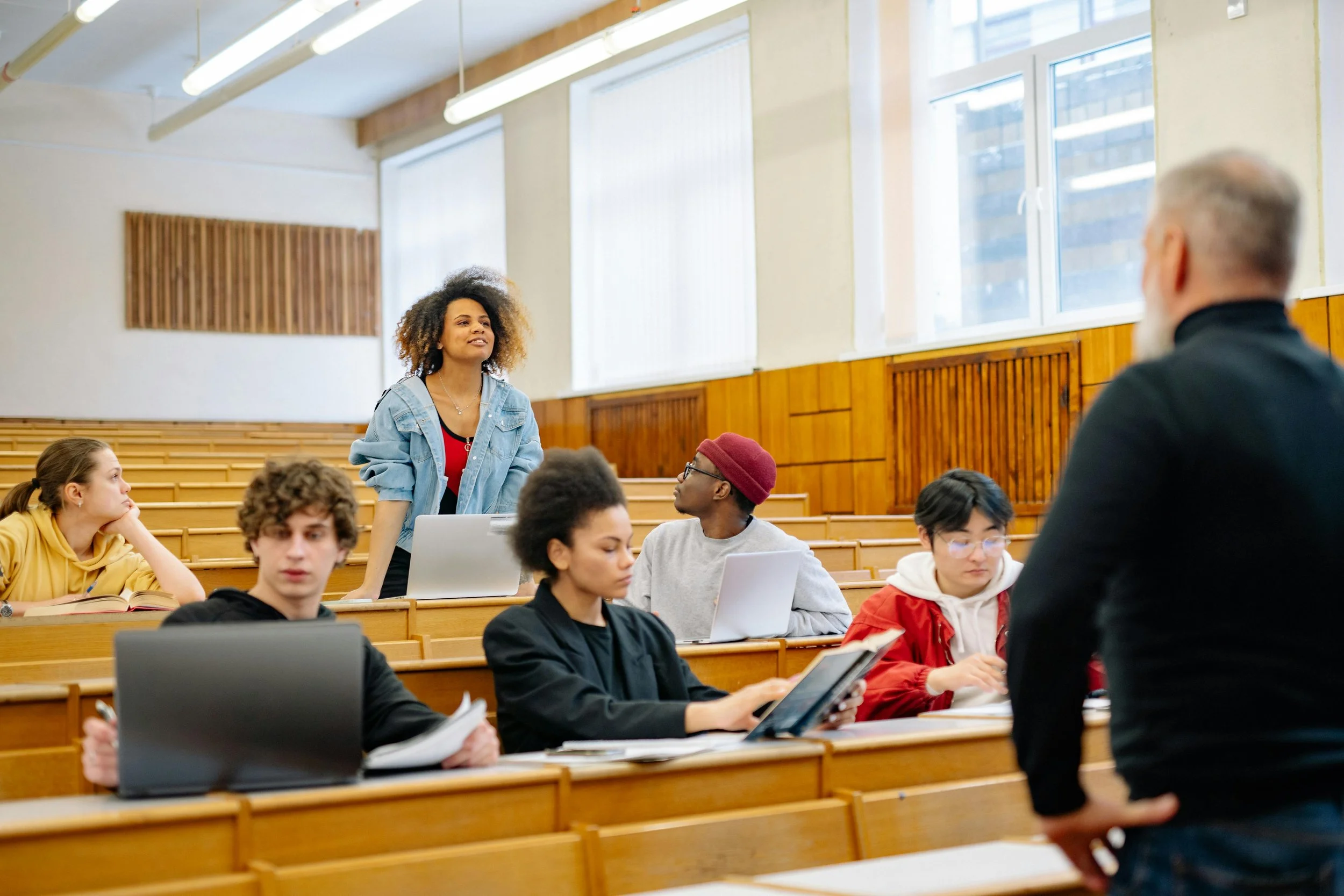
Nine out of ten college students say they want to engage in debate and discussion with their peers. 43% even describe themselves as very or extremely interested, regularly seeking these conversations out and sometimes initiating them.
68% agree that exposure to a wide range of viewpoints is essential to a good education
70% want opportunities to build their debate skills
78% have actually changed their minds on an issue because of a debate
By nearly every measure, this generation has internalized what higher education asks of them: engage, question, argue well, and remain open.
The demand for discourse is not missing. What's missing is an environment where it can actually happen.
Let’s explore why – and what students say can be done about it.
Disagreement Has Become a Reputational Risk
Banjo surveyed 1,019 U.S. college students across 48 states and more than 600 two- and four-year institutions on the state of debate, free expression, and civil discourse on campus. The results reveal a significant and troubling gap between what students say they want and what they report experiencing.
64% of students say most debates today feel more hostile than productive.
This is not primarily an institutional failure. Students are not describing classrooms that lack debate programming or professors who shut down discussion.
They are describing something harder to fix: a social climate in which disagreement has become high-stakes. Reputations are fragile, the loudest or most forceful voice tends to dominate, and the social consequences of saying the wrong thing — or simply saying something unpopular — can be swift and lasting.
The skills that debate requires, particularly listening, revising one's position, and tolerating discomfort, have given way to a culture that rewards performance over engagement and volume over reasoning.
57% hesitate to share opinions because they worry about how others will react
55% say they feel pressure to appear more informed than they actually are during discussions
61% say they would be more willing to share honest opinions in class if they could do so anonymously
When a majority of students identify anonymity as a condition under which they'd actually participate, they are not describing a formatting preference. They are describing a social environment in which genuine engagement carries a reputational cost they have decided is not worth paying in public.
Three-Quarters of Students Have Paid a Price for Debate & the Rest Have Taken Note
Students are not describing a vague sense of discomfort. They are reporting specific, concrete consequences.
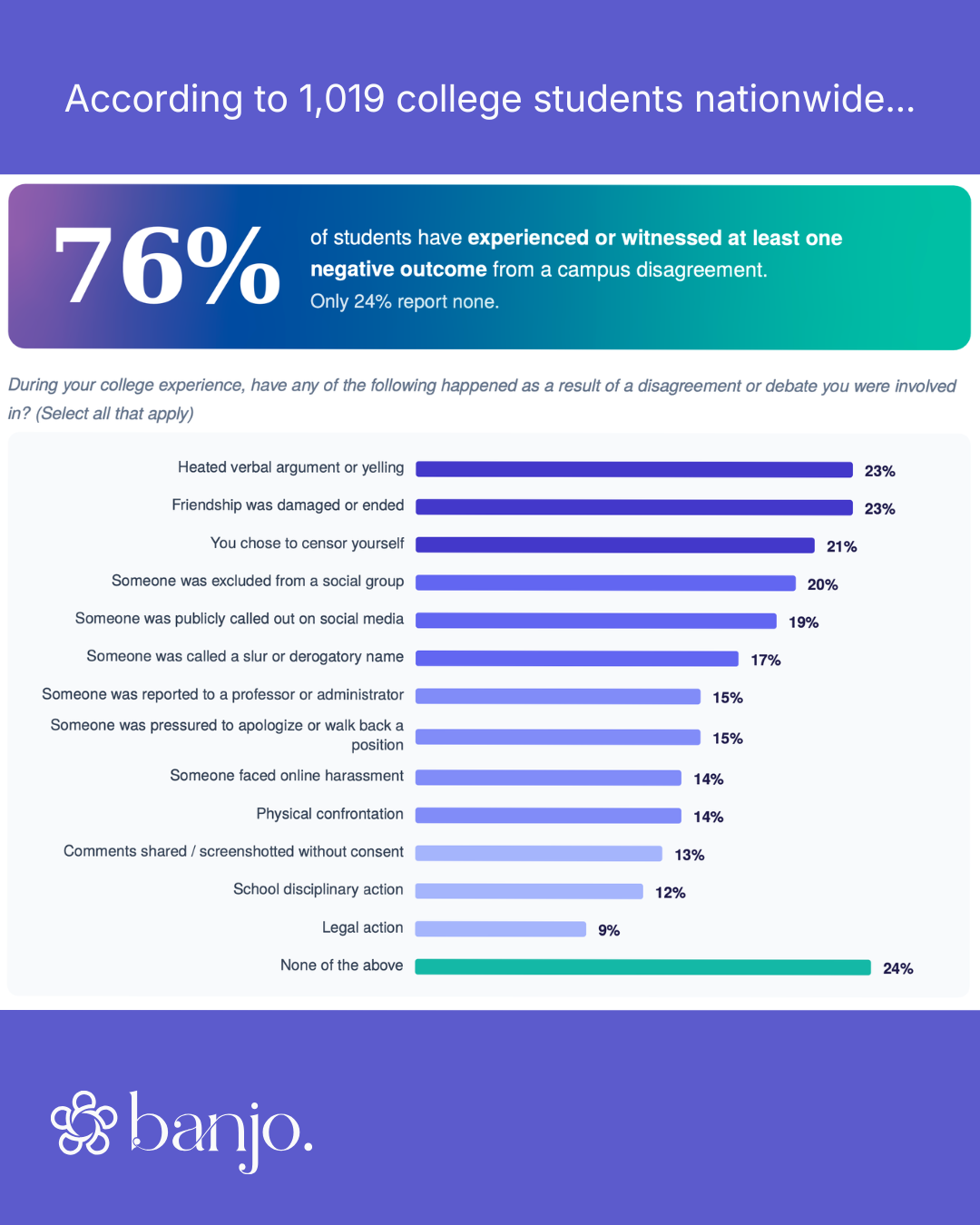
76% of students have personally been involved in a debate in which they experienced or witnessed at least one significant negative outcome. The list includes: damaged or ended friendships (23%), social exclusion from a group (20%), being publicly called out on social media (19%), being called a slur or derogatory name (17%), online harassment (14%), and physical confrontation (14%).
In their own words:
"Different political views ruined a friendship group." — 4th-year Digital Marketing student, Arizona State University
"People stopped talking to me after challenging their worldview." — 4th-year Criminal Justice student, University of Alabama
"I received death threats from other students due to my opinion on taking part in a club tabling event." — 3rd-year Political Science student
"During the lecture people started getting heated to the point where they used a derogatory term." — 1st-year Information Systems student, Texas A&M University
"There are some topics I feel I can't discuss with my peers — the Israeli-Palestinian conflict, abortion. I've tried to peacefully discuss my opinions before and have immediately gotten shut down and berated for them." — 4th-year Psychology student
These are not edge cases reported by outliers. They are common enough experiences that three quarters of the student population has encountered them firsthand. And because campus social dynamics are often visible and shared, students don't need to have personally faced consequences to learn what happens when someone does.
The Rational Case for Saying Nothing
The behavioral response is predictable, and the data confirm it.
66% of students report having avoided a discussion to prevent conflict in just the prior two weeks
64% report feeling anxious when discussing controversial topics
53% say they feel isolated or misunderstood because of their views
A third-year history student at the University of Wisconsin-Madison described the calculation clearly:
"I'd like to discuss controversial topics like politics or identity, but it can feel risky. Fear of judgment, social pressure to 'pick a side,' and discussions turning into arguments instead of real conversations often get in the way."
A first-year electrical engineering student at the University of Houston offered a more tactical version of the same problem:
"Sometimes due to the political climate I pretend to be more moderate than I truly am to convince my friends of my point and seem more rational."
When students begin misrepresenting their actual views in order to participate, the educational value of discourse is already significantly compromised.
The purpose of debate — to expose students to genuine difference, to sharpen arguments against real resistance, to practice the skills of persuasion and revision — depends on honesty. A campus culture that makes honesty feel too costly produces exchanges that look like debate but function as performance.
The Echo Chamber Hidden in Plain Sight
One of the subtler dynamics the data reveals is where students do feel comfortable expressing their views.
75% feel comfortable speaking honestly with close friends — by far the highest comfort level of any setting surveyed.
At campus events and panels, only 46% feel as comfortable speaking honestly.
Lectures and seminars, the settings most explicitly designed for intellectual exchange, are comfortable for just over half of students –— 55%.
The reason students feel safer with friends than in classrooms is not difficult to identify: 68% of students say their close friends already share their views, significantly higher than the alignment they report with classmates. The setting with the highest psychological safety is the setting least likely to produce genuine intellectual challenge.
"The current environment often prioritizes conformity over genuine, diverse expression of ideas,” a second-year business student said.
Students are not avoiding hard conversations because they lack interest. They are routing around environments that make those conversations feel dangerous, and finding refuge in spaces that are comfortable precisely because they are unchallenging. Higher education loses something important in that transaction.
A Generation That Never Learned to Disagree
Students are connecting the quality of discourse they experience on campus to outcomes in their own lives and to the health of civic institutions they are about to enter.
53% of students say the way people communicate and debate today is actively harming students' mental health
56% say the decline in civil discourse represents a threat to democracy
The habits formed in college — how to argue, how to listen, how to hold a position while remaining genuinely open to revising it — follow graduates into every professional and civic context they will encounter.
A generation trained to self-censor, to perform moderation rather than practice it, or to avoid disagreement rather than navigate it, arrives in the workforce and in public life without the skills that democratic participation and effective collaboration require.
The Demand Remains — and Students Know What Would Help
None of this has diminished students' appetite for debate. 53% of students want more structured debate opportunities at their school — roughly a 6:1 ratio over those who want less.
When asked to describe what productive debate looks like, students articulate a clear and consistent blueprint: equal opportunity to speak, active listening, diversity of viewpoints, a willingness to change minds, and — most critically — structure.
65% say structured formats would improve how students discuss difficult issues. Students are not asking for debate to be easier or less rigorous but rather for the conditions that make serious debate possible.
“[We need] clear structure and expectations. When students know the rules, the format, and what's considered respectful, discussions stay focused and people feel more comfortable speaking up." — 2nd-year Psychology student, University of Texas at Austin
"Most students are told to 'be respectful,' but not how. Schools should explicitly teach skills like active listening, steelmanning — restating the other side fairly — and separating people from ideas." — 3rd-year History student, University of Wisconsin-Madison
And when asked if they would use a platform designed for structured, respectful debate, 85% said they would — and 52% would use it often.
The more fundamental point is this: the problem on college campuses is not that students don't value debate. It is that the conditions and solutions that facilitate respectful debate have significantly deteriorated — or don’t even exist — and students are paying a real price for that gap. Follow along as Banjo works to close it.
The Discourse Divide is Banjo's research report on the state of debate and free expression on college campuses. Based on responses from 1,019 U.S. college students across 48 states and 600+ institutions, fielded April 3-11, 2026. Read the full report at banjo.media/the-discourse-divide.